Work that still resonates today
Cleaning the Drapes (From the series ‘House Beautiful: Bringing the War Home’ c. 1967-7)

Image ‘Cleaning the Drapes’ [accessed27/04/2019]: https://www.moma.org/collection/works/150123
This effecting image depicts a 1960s housewife vacuuming gold, floral curtains collaged over a monochrome photo of soldiers (as if a still from the news). She pulls back the curtain to expose something of great contrast to her own image. The juxtaposition of the tidy housewife, as if in an advert (with her seemingly trivial task) and the soldiers in peril is striking. Given the time that this work was created Martha Rosler’s purpose may be to point us to the US government and media’s coverage of the Vietnam war and its compression of such terrible things into news articles and documentaries, detached from the average American’s reality. The use of the image of the housewife also points to the restrictive role of women in society. The helplessness of the housewife only able to view what is happening is portrays this very well. I feel that the washed out look of the colour in this image, of pale gold, black and white, adds to the feeling of this image somehow being unreal.
I enjoy this work and find the message and execution effective. The spotlight it shines on the western attitude of immersing ourselves in frivolous distractions whilst others’ suffering seeming remote to us is surprisingly relevant in the social media age. The restrictive role of women too is still an important subject matter today; with the MeToo movement recently highlighting how far society still has to go in terms of equality. This work can also be placed in the wider subject matter that many artists tackle of others’ suffering supporting our privileged western lives and I think the advert style used for the housewife is a hat tip to this.
Red Stripe Kitchen (From the series ‘House Beautiful: Bringing the War Home’ c. 1967-7)
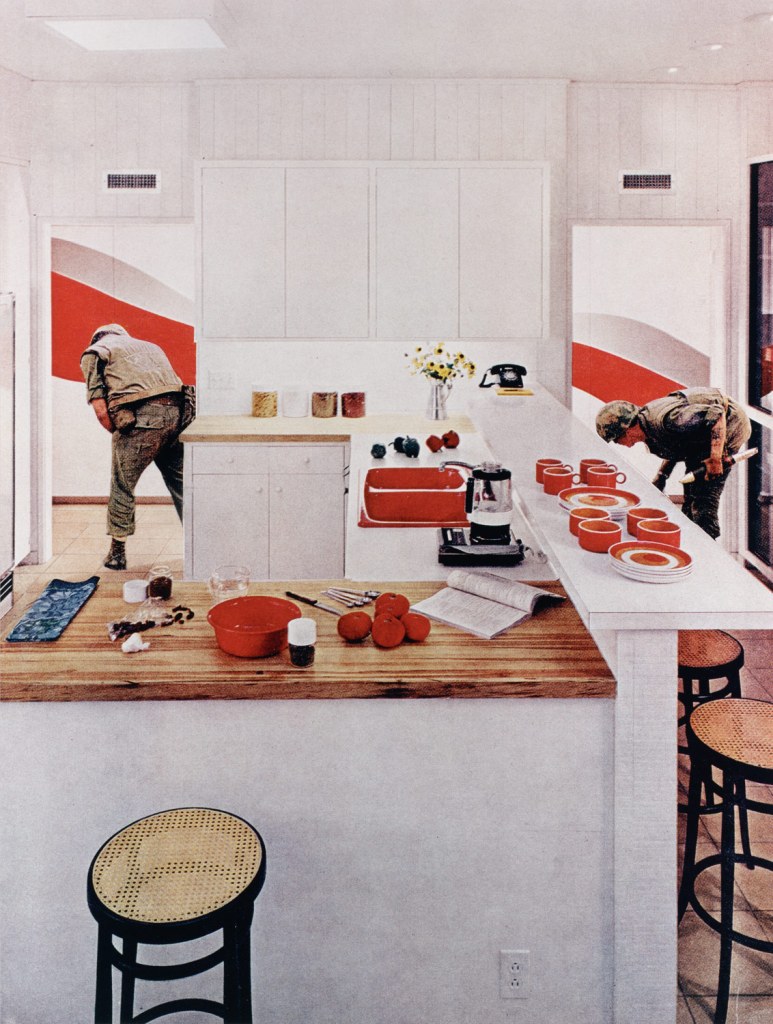
Image ‘Red Stripe Kitchen’ [accessed 27/04/2019]: https://www.metmuseum.org/toah/works-of-art/2002.393/
From the same series as ‘Cleaning the Drapes’, ‘Red Stripe Kitchen’ holds a similar message. This magazine style image of a modern kitchen (60s modern) does not contain a domestic goddess ready to demonstrate new kitchen gadgetry but soldiers who appear to be looking for something, maybe explosives. The contrast of the glossy kitchen in its crisp colours and the practical appearance of the soldiers ready for war is unnerving; as if peril has come to this sanctuary of domesticity. Again I feel this image is a critique of western society’s detachment from wars that our governments fight. It is as if she is saying ‘Wake up!’
Balloons (From the series ‘House Beautiful: Bringing the War Home’ c. 1967-7)
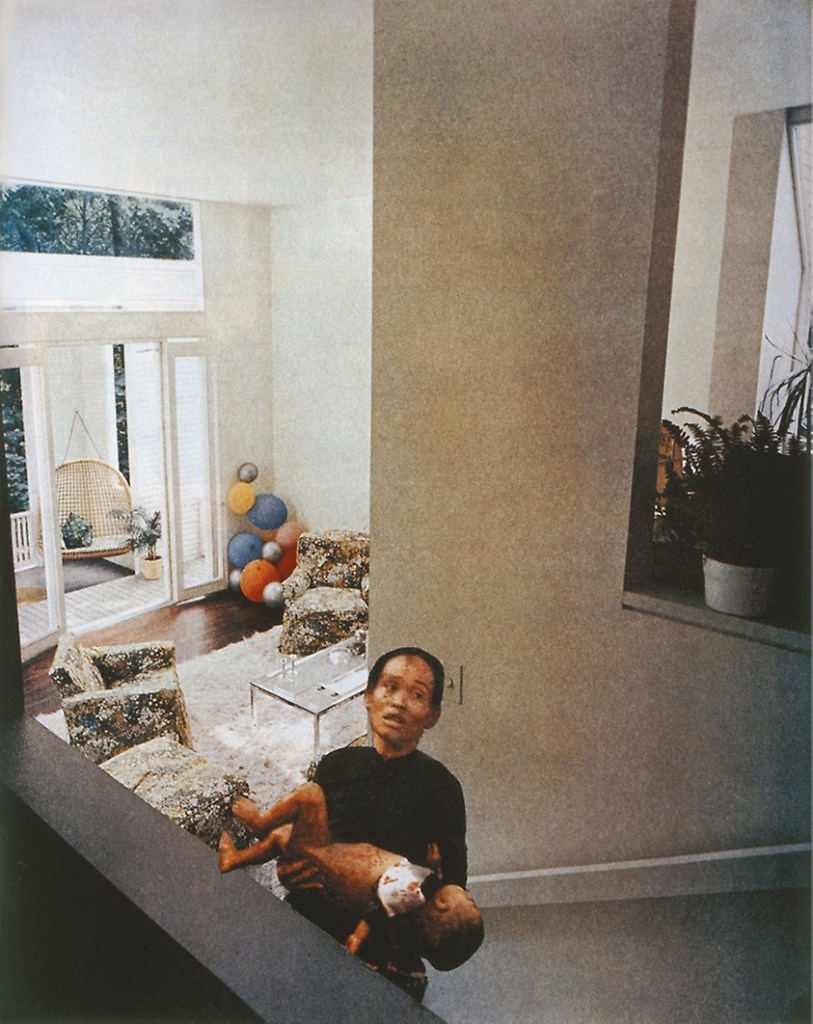
Image ‘Balloons’ [accessed 27/04/2019]: https://www.artic.edu/artworks/195582/balloons-from-the-series-house-beautiful-bringing-the-war-home
Depicted in this image from the same series is the very emotive image of a man in distress carrying his injured or maybe dead child, potentially after a napalm attack. Martha Rosler once again places this distressing image where it appears not to belong. The home he is in seems peaceful and stylish and there are balloons in the corner of the room, maybe from a child’s birthday. The child that lives in this house has a very different life to the child in the man’s arms; a life of parties, safety and shelter. Due to them being the only bright colours in the image, the balloons are the first thing your eye is drawn to, then the man with the child. This creates a connections in your mind between the child seen and the child that is unseen. The positioning of the man on the stairs is a clever device as it invokes childhood memories of being carried up to bed and given another life this is maybe what the man would be doing.
Conclusion on – House Beautiful: Bringing the War Home’ c. 1967-7
Whilst I find all three of the images I analyse here work very well in conveying their message ‘Balloons’ is the image I find most emotionally effecting. I find the image is upsetting and therefore it makes a strong impact to convey its message. The use of the innocent child as an image and the distress of the parent are relatable subjects to a large number of viewers. I also find that ‘Cleaning the Drapes’ has a strong impact on me as I feel the imagery very clearly explains its purpose. I am, however, aware of my own bias here as I relate to the message of the restrictive role of women in society, occasionally experiencing this first hand. One of the most effective elements that is used throughout the series is that if the images are just glanced past they simply look like adverts, it’s only when you engage with them properly that the subject matter is revealed.
Photo Op (from the series ‘House Beautiful: Bringing the War Home, New Series’ c. 2004)

Image ‘Photo Op’ [accessed 27/04/2019]: https://www.tate.org.uk/whats-on/tate-modern/exhibition/level-2-gallery-media-burn/level-2-gallery-media-burn-martha-rosler
The continued relevance of ‘House Beautiful: Bringing the War Home’ can be seen in the fact that Rosler decided to produce an updated version of the series in 2004. In ‘Photo Op’ the same themes can be seen but the work has an updated style for the new millennium. Again here we see a modern apartment with neutral, stylish furniture. Our central figure however is no long a 1960s housewife but a ‘party girl’ or rather two party girls dressed exactly the same for a night out or maybe even a film premier. They both appear to be taking selfies or they may be on a video chat (as the image on the phone is not their own). There is a war raging outside which both seems oblivious to but worse still they seem totally unconcerned by the dead children slumped in their living room chairs; they are only concerned with their world. Another possibility is that they are using the war image as their ‘photo op’, this implies that not only are we, as a society, unconcerned by the suffering of others but are so used to seeing the images on news, documentaries and film that war may be seen as merely something of interest that only happens to others.
This work is clearly a comment on the Iraq war (the ‘war for oil’), how money from it could be supporting western privilege and our obsession with celebrity in the early days of social media. It still maintains much of the message from the original series but the trivial task here is the photo or video chat. This image also expresses concern for the role of women in society but this message has evolved and now points to conventional and prescribed ideas of female beauty and the societal pressure to conform to these standards (as can be seen in the duplication of the same image). Rosler executes an effective reworking and shows how the original how the original message is still relevant today.
Self Assessment:
I enjoyed this ‘treasure trail’ of research, in which the research of one artwork leads me on to another artwork to research and so on. I feel this expanded my understanding and knowledge in an enjoyable and natural way. However, if this research was for a specific assignment or purpose I would need to know when to limit my research and identify what is relevant rather than hopping from one topic to the next.
I surprised myself with my lack of worry in getting the answer ‘wrong’ as I feel this is something that has held me back in the past and I hope this honestly is something I can continue with and develop further.
I feel my visual language vocabulary needs some development as I struggled not to repeat myself (hopefully the use of my arts dictionary will help me). I also need to work on being more concise and staying focussed on the main topic. I think the system of writing initially in my learning log notebook and then summarising further in my blog that I am using will be a great use here.
Further Research
In my research of Martha Rosler I read an interesting interview of her on the Tate’s website at:
In this she talks about what artists have influenced her work and about the sources that she uses for her artwork and this has inspired me to have a go at my own Martha Rosler style photo collage to further understand her process; this will also follow in a further blog post.
 Lucy's OCA Learning Blog