Inspired by an interview of Martha Rosler I read on the Tate website, I have embarked on a project to create a similar photo collage myself, based on the space race (in part as it is nearly the 50th anniversary of man landing on the moon). This is my attempt to understand Martha Rosler’s drive to put across her message and her process more thoroughly.
Martha Rosler interview: https://www.tate.org.uk/whats-on/tate-modern/exhibition/ey-exhibition-world-goes-pop/artist-interview/martha-rosler [accessed 19/04/2019]

I came across the image above on the Met Museum website archive (https://www.metmuseum.org/art/collection/search/786299?&searchField=All&sortBy=Relevance&ft=apollo+11&offset=0&rpp=20&pos=6 – [accessed 30/05/2019]) and have decided to make this my starting point. This image of President Nixon welcoming the Apollo 11 astronauts aboard the recovery ship after their return from landing on the moon is an historical image that fascinates me. It is a picture of great joy and celebration of human achievement at a time of great tension and fear. The moon landing so famous for its scientific achievement has dark side to it.
Here we see the smiling faces of the astronauts as they are welcomed to safety by the head of the nation that sent them on their mission. They look relieved to be safely home to earth and although we remember the success of the Apollo missions they were very dangerous and no one really knew if these men would survive. Previous missions had claimed lives so their relief is unsurprising. They are still in quarantine in this image and therefore still separate from the earth to which they have returned; they still only have each other. The unit they are talking from looks functional and clinical; a place of practicality not comfort. President Nixon’s body language is relaxed in that moment, a man enjoying the success of a job well done, however I think you tell by his posture that this has generally been a time of tension (his shoulders are quite rounded showing long term tension – but I guess all presidents probably have this).
Man landing on the moon is undeniably an incredible achievement and I am not wishing to take anything away from that but I think it is an interesting and classic example of a government dressing something up as a positive, peaceful endeavour when really there are military concerns at play. If you look up information regarding the moon landing (https://www.nasa.gov/) the information given speaks of achievement and success but if you look up ‘space race’ there is talk of competition and military threat. I think this shows that the moon landing was one step in many years of tension and one-upmanship between the United States and the Soviet Union and I would like to reflect this hidden agenda in my work.
The Outer Space Treaty:
This is a treaty (entered into force in 1967) to prohibit the use of space for military purposes. It specifically prohibits the placing of weapons of mass destruction in the earth’s orbit or on celestial bodies such as the moon and weapons testing or military bases. The treaty also bans states from claiming celestial bodies such as the moon and thus the placing of the star and stripes on the moon is merely a symbolic gesture.
This treaty was obviously made necessary by the dangerous attitudes and arrogance shown during the space race and I find it chilling that we ever needed a treaty such as this. It demonstrates the tension of the time and how precarious the situation was.
Information source: http://www.state.gov/t/isn/5181.htm
Notes on information from the Khan Academy website (https://www.khanacademy.org/humanities/us-history/postwarera/1950s-america/a/the-start-of-the-space-race – [accessed 01/06/2019]):
- The ‘space race’ was a cold war competition between the US and Soviet Union to develop artificial satellites, unmanned space probes and human space flight.
- The Soviet Union had early success and launched the world’s first artificial satellite (Sputnik I) in October 1957 and put the first man in space in April 1961. This clearly frightened the US and they felt they had to step up their research.
- The Soviet Union’s early success effected US society. They began new education initiatives in maths, science and languages (that were considered of use) and altered defence doctrines.
- A big driving force in the space race was the perceived ‘missile gap’. Progress shown by the Soviet Union in the space race was believed could be used to create Intercontinental Ballistic Missiles capable of delivering nuclear warheads to US targets.
- Government sponsored propaganda and TV/movies in general heightened fears and paranoia during the space race.
The space race appears to have been a way of demonstrating weapons capability and military might without actual conflict. The media seems to have played a part in creating an atmosphere of tension and fear and this something I would like to investigate further.
The Speech:
I remembered when doing this research that I had seen an article some time ago about an undelivered speech of Nixon’s that had come to light in the years after the moon landing. This was a speech prepared for him to deliver in the event that the Neil Armstrong and Buzz Aldrin became stranded on the moon and ultimately would die there. Unfortunately I was unable to find the article but I have found a copy of the speech in the US National Archive (please see the link below for a copy). This speech made such an impact on me because it is a fascinating and frightening glimpse into an alternative reality the results of which are unknown. At such a precarious time I wonder how the loss of the Apollo 11 astronauts would have effected society and the events of the cold war in general.
Source: https://www.archives.gov/files/presidential-libraries/events/centennials/nixon/images/exhibit/rn100-6-1-2.pdf [accessed 01/06/2019]
Life Magazine

Life magazine was an American general interest magazine popular in the 1950s and 60s and known for it’s photography. This has been the most interesting resource that I have found (in Google books) regarding the cold war and space race. As a primary source of the mood at the time it is fascinating glimpse into the national psyche of the US during the cold war. It has an amazing mix of reports on the terrifying political climate next to adverts for domestic niceties and articles about celebrities. This magazine is so surreal because news reports on a coming nuclear war are cheek to jowl with the most frivolous articles. As I write this I am aware of my hypocrisy as I have a weakness for fashion magazines in a time of Brexit and Trump; probably in part because they are frivolous escapism and this makes me wonder if things have really changed much.
Life Magazine 20th Oct 1961: ‘Communism a three-part series’
A great example of this disorientating format is the edition released on 20th Oct 1961 entitled ‘Communism a three-part series’ which is heavy with propaganda and adverts for domestic appliances.
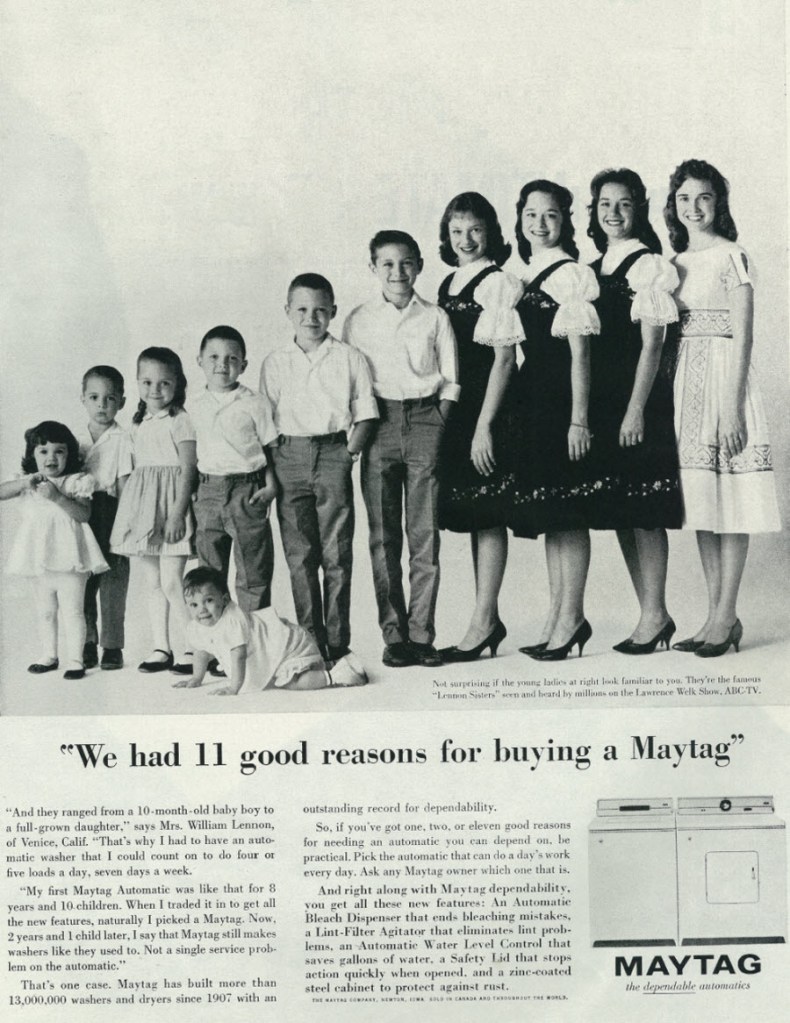
On page 106 of this edition is an advert for Maytag washing machines (pictured above), the image of which is the 11 children of Mrs William Lennon who is the washing machine’s champion. Here stand Mrs Lennon’s fresh faced, clean, smiling, all-American children in height order and co-ordinating outfits. They are the picture of health and tidiness; presumably what Maytag and Life Magazine considered a wonderful family and a family for every woman to aspire to. How is this marvellous family so clean and picturesque?…Maytag washing machines of course! The picture and text both convey that this very reliable washing machine (according to the text) has made this all possible. This advert is clearly aimed at housewives and is based on and further feeding into 1960s society’s image that a woman’s achievements are judged by her ability to be a good homemaker. It may be implying that Mrs Lennon is living her dream of being the mother of such a large family which would have previously been an arduous task washing wise but she can achieve it with the help of this washing machine.
Like many adverts in Life Magazine it is presented like an article with the title “We had 11 good reasons for buying Maytag”. This format means that you give it more attention and makes it feel of more importance and as if the views in it have more authority.
If this was an advert in today’s media I’m sure I would find it jarring and patronising in its content but as an historical image I find it an interesting conveyance of how women lived and were viewed. In stark contrast is the article that follows about communism.

Page 107 of this edition is almost a complete contrast (shown above) to the advert it’s opposite. It is the beginning of an article entitled “A series on the mounting threat to us all: Communism”. An introduction to this article which starts “Americans live a missile flight from the explosive danger of Communism” (even the Americans pictured in the advert before) is presented on top of a monochrome image of the Kremlin. This actually quite brightly coloured building is shown here almost in silhouette. The building appears dark with a slight mist surrounding it. There are some figures walking past it who are dwarfed by the huge scale of this imposing building. This image of the Kremlin could almost be a shot from a horror movie of a haunted building with its dark towers and mist. This image is clearly used to convey threat and evokes thoughts of a dark power that is unseen. It conveys this through colour, shade and scale and the people below seem tiny and helpless.
This article has a tinge of propaganda about it and the summary ends by telling us that this is part 1 and there will be part 2 and 3; part 3 promises to put forward methods by which “we can mount our own counterattack”. The wording and imagery is highly emotive and no doubt was very effective in spreading fear of an attack by the Soviet Union.
This must have been a confusing and terrifying time as just in these 2 pages you can see the contrast in the American media. The Magazine is showing you the American dream and at the same time how it could all be snatch away.
Further research for useful images and into Life Magazine
My main interest in the space race was its apparent military threat and the effect it had on society so I decided to do a search for images of the destruction left by weapons of mass destruction. This led me to find an article on the Time.com website (the owners of Life Magazine) of images again from Life Magazine but these images were never published. The article displays and discusses images taken for Life Magazine of Hiroshima and Nagasaki in the weeks and months after the atomic bombs were dropped on the 2 cities. No one knows why these images were never published but the article hypothesises that they “too readily humanized an enemy that had been so effectively demonized and dehumanized for four long, brutal years.” I feel that Martha Rosler would be interested in this because it shows the media’s control over how we view the world and how much they can influence public opinion.
The images are chilling and show just how destructive the atomic bombs were. I have picked 2 of the images to discuss below:

https://time.com/3494421/hiroshima-and-nagasaki-photos-from-the-ruins/ [accessed 04/07/2019]
The above image had a lasting effect on me and I think the imagery depicted says a lot. We see in the background the remains of Urakami Cathedral, the two walls that remain are the only structures that have stayed standing in this picture and so you can see miles of rubble and in the midground a couple of makes shift dwellings of survivors alone in what was once their city. The most striking part of this image is the skeleton in the foreground. It is not clear what animal this skeleton came from but it reminds me of a dinosaur skeleton that you might see in a museum and this image hints of extinction. The composition is effective too; the skeleton, once full of life, is looking towards the cathedral as if for salvation from some unseen deity but none has come. This image tells of the potential for this new type of weapon to play a hand in our extinction and the make shift dwellings show the desperate attempt to survive.

https://time.com/3494421/hiroshima-and-nagasaki-photos-from-the-ruins/ [accessed 04/07/2019]
The image above tells a similar story to that of the previous image but has an emptier feel to it. This area a couple of months before would presumably have been bustling with city life but now we see it empty except for rubble and burnt trees. The remaining reminders of this city life are two burnt buses and the shell of a building in the background. This image expresses the suddenness of death in Hiroshima. These buses once full of people and in motion have been stopped suddenly in their tracks as if frozen in time. There is so much rubble in this image and you can see far into the distance; a view that would have previously been blocked by the buildings that are now rubble and people that are now dead. In the distance you can see the shell of a building; it is only partially still there, like a ghost, like all of Hiroshima. The eerie emptiness of this photograph not only gives a sense of the scale of the destruction in Hiroshima but also makes you think of the people that once occupied this space as your brain tries to make sense of this unnervingly lifeless image.

https://time.com/3494421/hiroshima-and-nagasaki-photos-from-the-ruins/ [accessed 04/07/2019]
The above image shows the struggling survivors in the aftermath of the Atomic bomb dropped on Nagasaki. Here they are shown collecting branches on a old fashioned cart. It is not clear why they are collecting branches; maybe for firewood, maybe as part of a clean up attempt. The scene behind them is so empty and they are the only figures in it; this makes me think of the terrible loss the people in the photo must have endured and how alone and abandoned they must be feeling. The cart and their clothing are old fashioned in style for the time of these photos and this conveys that they have been forced from their previously comfortable, modern life back in time to a life of struggling and with few comforts (whilst America continues to enjoy modern comforts in abundance). These people may have been successful or influential in Nagasaki but this photo is a shuddering reminder of how war can reduce us all to desperate scavengers trying to survive. The figure pulling the cart seems surprised to be photographed or maybe bewildered at having a spectator to their misery or worn down by the struggle to survive.
Whilst these photos are not from the same era as my starting point photo, I think the use of one of them in my photo collage would be effective. Not only are they a real life reminder of how devastating weapons of mass destruction are but they are images of the aftermath of weapons of mass destruction detonated by the nation that won the race to the moon. I previously considered including the image of the Kremlin from the Life Magazine article on Communism in my photo collage but I don’t feel this would convey the message I intend but the images of the bomb destruction would.
Please note this article will be updated further with more information as my research progresses.
 Lucy's OCA Learning Blog