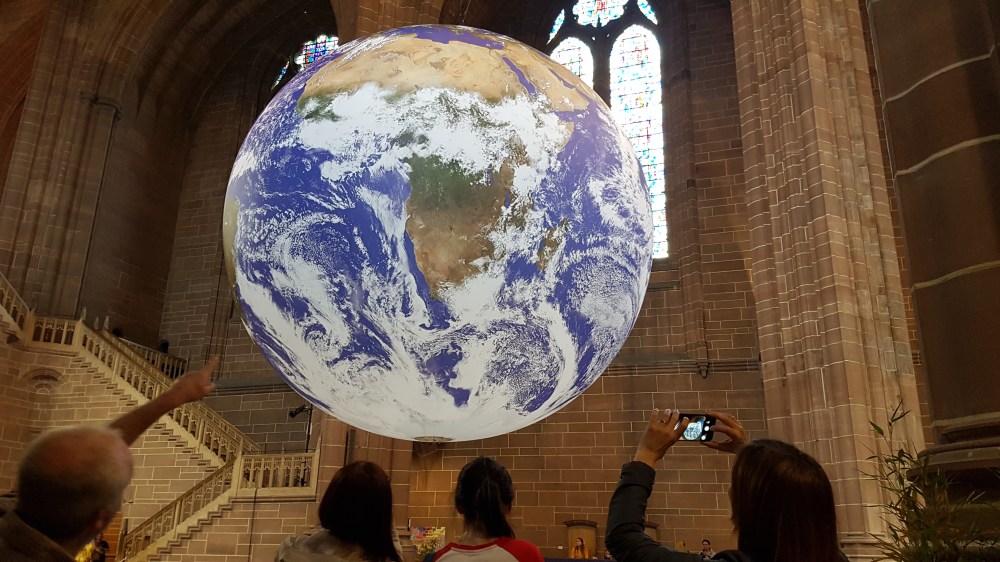
I visited the installation ‘Gaia’ by Luke Jerram in Liverpool cathedral on Saturday 1st June. Gaia is a glowing sphere displaying detailed imagery provided by NASA of the earth’s surface as seen from space. It is suspended from the cathedral’s high ceiling opposite one of the cathedral’s brightly coloured stained glass windows and greets you as you first come into the main part of the cathedral (in an area that I believe is called the Well).
I was very keen to see this as I am fascinated by the complexity and balance of nature and seeing accurate images of land and sea, all at once, seen from such a distance was an exciting prospect. However, I must confess it did not have the impact I anticipated it would.
It is large in size but not so large that you have to view it from a great distance to see the whole artwork properly and is hung above head height to give it a grandness. It depicts, as promised, land masses of green vegetation and sand coloured deserts; blue seas and white/grey weather fronts. The earth from a distance is undoubtedly interesting but whilst it is interesting to see the accuracy of the images, I fear that the artist’s vision is not fully realised in this location. The desired impact I believe is to create a sense of awe in the viewer and to simulate the ‘overview effect’ a feeling of awe, understanding and sense of the preciousness of life that astronauts have described experiencing when viewing the earth from space. They have attributed a renewed drive to protect the planet to this experience. I believe the artist’s ultimate goal is to have viewers leave with this drive and the resolve that they need to join the fight against climate change.
“I hope visitors to Gaia get to see the Earth as if from space; an incredibly beautiful and precious place. An ecosystem we urgently need to look after – our only home.” Luke Jerram – https://my-earth.org/about/ [accessed 08/06/2019]
Unfortunately, viewing it in a busy cathedral in the day, when its glow is not as clearly seen did limit its impact. I understand why a cathedral was a choice of location that seemed appealing; the high ceilings, a peaceful place of prayer but I went at the weekend when there was an arts market on and Gaia is located quite near the café and gift shop which creates a lot of foot traffic. This coupled with stained glassed windows and staircases behind it made for a visually and auditorily noisy background thus distracting from the calm, majestic image of the earth. I wonder also if the image of a globe has become too common place an image seen on posters and maps and this limited its impact on me somewhat and made it feel quite ordinary.
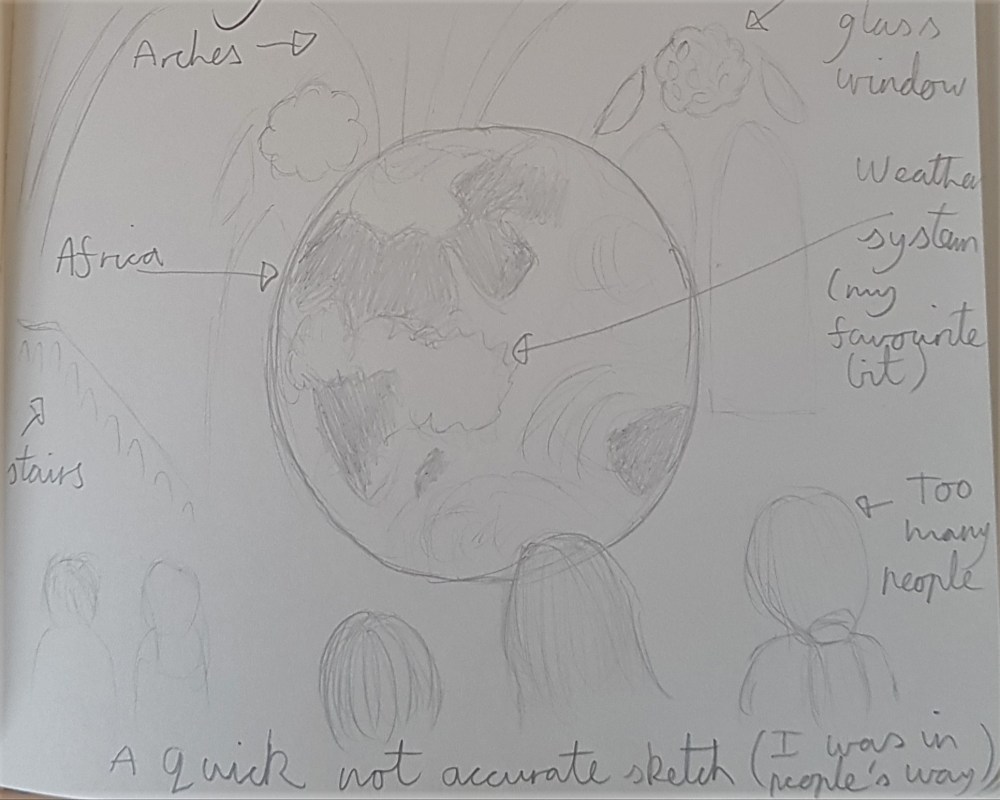
Quick sketch from visit to ‘Gaia’ by Luke Jerram 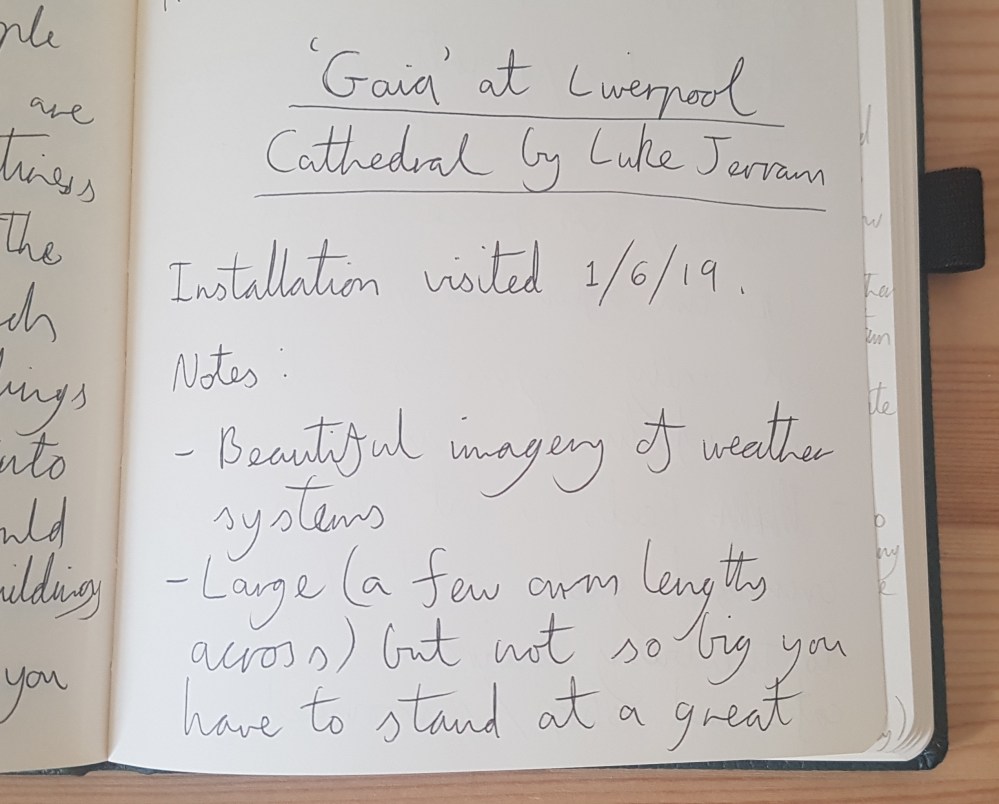
Initial observations of ‘Gaia’ by Luke Jerram 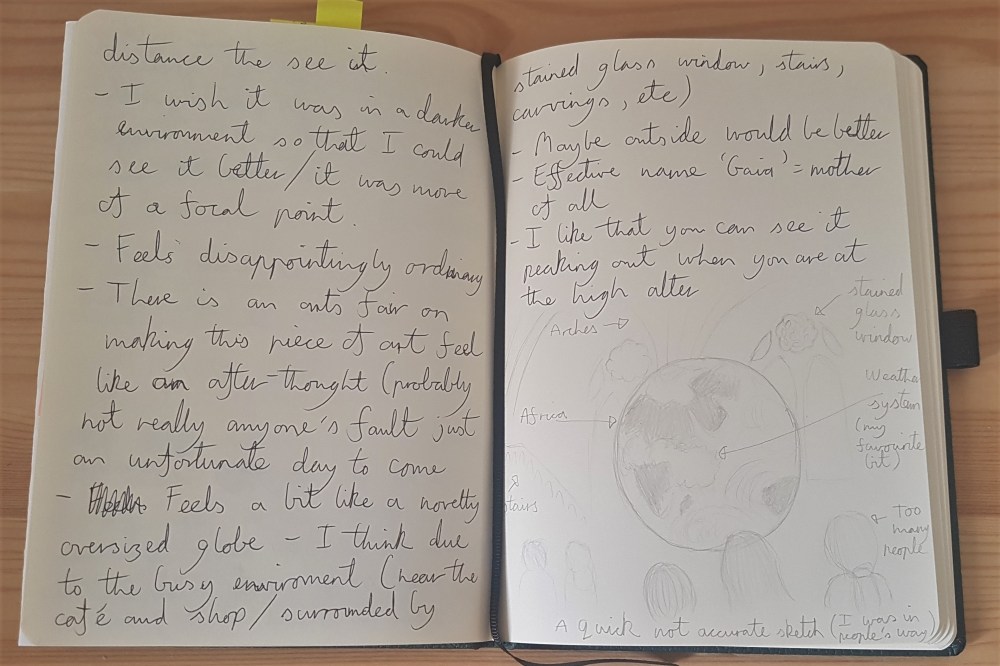
Initial observations of ‘Gaia’ by Luke Jerram
I think this installation belongs in a less busy and more natural environment. In nature, such as when it was displayed over the dipping pond at the Helix Park, Falkirk (shown below), I’m sure it would have had more of the desired effect and would appear peaceful and majestic, especially glowing at night. I think this for two reasons; firstly being a sphere showing images of nature (albeit from a great distance) I think it would have more harmony with a natural setting but its grand scale would also make it feel unexpected and therefore would draw people to it. Secondly, in a less busy environment it can be the main focus of attention as it is intended and as the earth would be to an astronaut viewing it from the darkness and quiet of space.
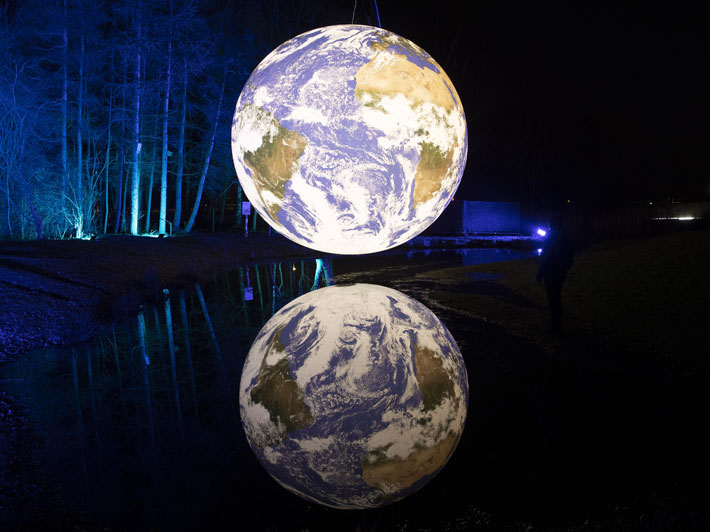
https://my-earth.org/installations/fire-light-2019/ [accessed 06/07/2019]
Something I did find effecting about the location was that Gaia could be viewed from further into the cathedral, as far as the high alter, popping out from below an arch (as seen in the picture below) and this made it eye catching and haunting. It was as if it and the issue of climate change were unavoidable and were stalking you.

Another part of ‘Gaia’ I felt was effective was the choice of title. I find it very accurately sums up the purpose of the of the piece. In Greek Mythology Gaia was a goddess and the first being in existence. Not only is she the representation of Earth but gave birth to much of the natural world and therefore can be thought of as the mother of everything (source material: ‘The Oxford Companion to World Mythology’ by David Leeming, Publisher: Oxford University Press, printed 2005, published online 2006 – accessed 11/07/2019). This shows the intention to create a bond between the viewers of ‘Gaia’ and our earth and to encourage the viewer to see the earth as a parent and therefore treat it with the equivalent respect.
Self Assessment:
Whilst I feel that my trip to see this artwork was successful and enjoyable, I feel that I could have planned it better. On the day that I visited it, there was a busy arts market in the cathedral and therefore it was quite difficult to stand in one place and just view the artwork. This is why my sketch is quite rushed as I could not spend the time I would like drawing it. This emphasises to me the importance of planning a trip thoroughly. However, I am happy with the research I have done and with my personal observations of the piece.
 Lucy's OCA Learning Blog