Notes and response to ‘I Give Everything Away’
The 220 drawings represented in this video are an extraordinary insight into Louise Bourgeois. The work is incredibly open and vulnerable which I think is a good introduction to the artist’s work. Not having previously been aware of Louise Bourgeois’s work, I was struck with the cathartic nature of this series of drawings. These 220 works from a period of terrible insomnia seem to have been a type of therapy for Bourgeois.
The main points I learned:
- Bourgeois’s background is routed in surrealism and she emerged towards the end of abstract expressionism
- Whilst she initially made her name in 1950s but she was still making young, ground breaking work in 1980s and 1990s. Constantly current and challenging, right to the end
- The 220 works discussed here are small works on paper. A mix of drawing, pen and paint
- The works were created at night in that strange time between sleeping and waking
- These windows into Bourgeois’s mind are in some ways more honest and personal than her big sculptures
- They contain a lot a writing; poetic as well as artistic

I particularly like this image from the collection. I think anyone who has suffered from insomnia can recognise the feelings of anxiety in this picture. The lines drawn seem tense. I can imagine Bourgeois up at night continually, obsessively adding shape after shape to this page. In the end the image looks like bricks on a pyramid you may struggle to get up or a maze from which you would struggle to get out. It creates a feeling of being trapped.
Further learning on this exhibition from ‘Tracey Emin on Louise Bourgeois: Women Without Secrets – Secret Knowledge’ (video below):
Frances Morris (curator) and Tracey Emin on the insomnia drawings:
- Drawings reveal a different side to Bourgeois than people usually saw; the side that remained when everyone else had gone
- The drawings exist between reality and imagination
- A combination of memories and worries that were haunting her
- The drawings are so honest because they were never made to be seen
- Shows Bourgeois’s own psycho-analysis
“I have failed as a wife,
as a woman,
as a mother,
as a hostess,
as an artist,
as a businesswoman,
as a friend,
as a daughter,
as a sister,
I have not failed as a truth seeker.”
Louise Bourgeois
The above quote that was included in the exhibition with her insomnia drawings shows the deep and brutally honest self psycho-analysis that Bourgeois undertook in life and in her work. It shows how depressed she would sometimes become. It is also a demonstration of her use of language in her work and her poetic nature.
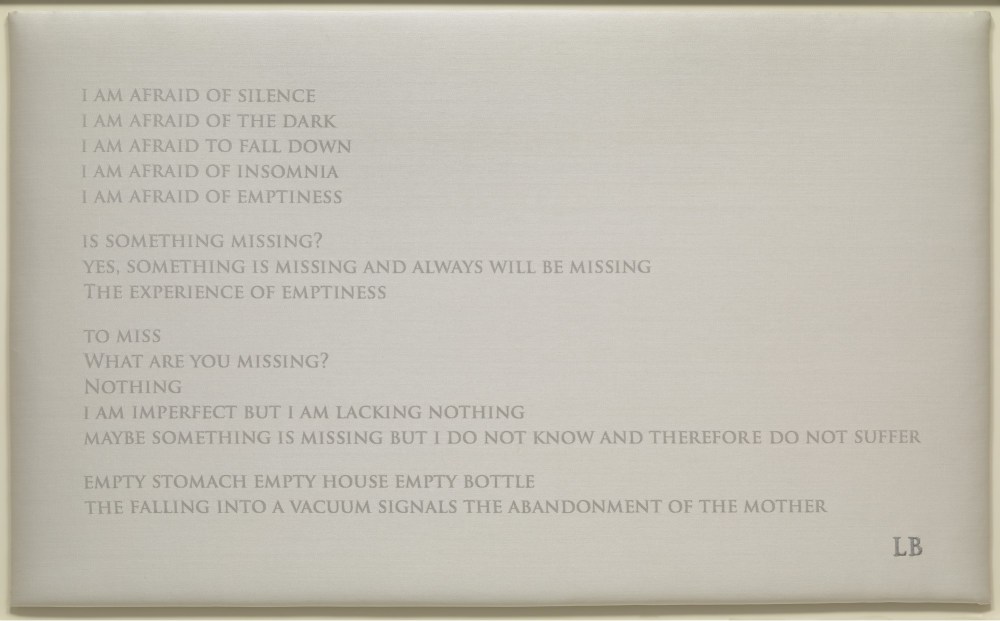
‘I am afraid’ is another good example of the poetry in Bourgeois’s work. This appears to be a conversation with herself about fear and feelings emptiness. It could be a work about the loneliness of old age and the fear that comes with it. Heartbreakingly honest statements like ‘I am afraid to fall down’ make this a simple but emotional piece of work. The fact that it is a conversation with herself shows her loneliness but it also shows balance. Here she has two sides; one is strong minded, the other questioning. Her use of woven fabric here also shows her versatility when it comes to the material she chooses.

The insomnia drawings were accompanied in the exhibition (discussed in the video below) by a series of large prints produced towards the very end of Bourgeois’s life. The prints are large and energetic and paint has been added to them to give colour. They are abstract but familiar looking images. Only one contains a figure but they are all visceral and human. They are not so much figures but what is internal in the human body; intestines, blood, etc. Again she uses words in this work to great effect; words like ‘I am packing my bags’ or (as above) ‘I leave the nest’.
As these were produced towards the end of her life, this work is about her considering her own mortality. She is talking about going on a journey, her final journey. The images are of the breakdown of what we are and in this maybe she is considering what will become of her body and thus considering the transience of human life.
I find these images not only very moving but very brave. Here Bourgeois shows such vulnerability and this makes these images beautiful and emotional. Death is something we all go through and old age most of us go through and yet we try not to think about it. Here Bourgeois is again using art as therapy, facing up to that innate fear of death.
Further notes and response to ‘Tracey Emin on Louise Bourgeois: Women Without Secrets – Secret Knowledge’
The first note I took down from this video was a quote from Louise Bourgeois that I really think sums up how cathartic her work is and the driving force and purpose behind it.
“In order to liberate myself from the past I have to reconstruct it, ponder about it, make a statue out of it and get rid of it through making sculpture. I’m able to forget it afterwards. I have paid my debt to the past and I’m liberated.”
Louise Bourgeois
I feel the same way about the art that I do. I feel that sometimes it is a kind of therapy that keeps me sane and helps me realise how I feel about certain subjects or events in my life.
The main points I learned:
- Bourgeois’s main themes are abandonment, loneliness and sexuality
- Her work is confessional and confrontational
- Her work is both emotional and intellectual; simple work with complex meaning
- Uses a vast array of materials – bronze, fabric, print, paint, pencil, pen, etc
- Most famous for her spider sculptures
- She was formidable and intensely emotional; She used to throw tantrums
- She worked for 40 years before she broke through to the mainstream in 1982 when she had an exhibition at MoMA
- Her father’s 10 year affair with her English tutor profoundly effected her and you can see this sometimes in her work
- A lot of her work is about her Mother and Father’s relationship
- Motherhood also informs her work often
“There is no doubt a woman has made these works.”
Tracey Emin talking about Bourgeois’s various works
Poids by Louise Bourgeois (1993)
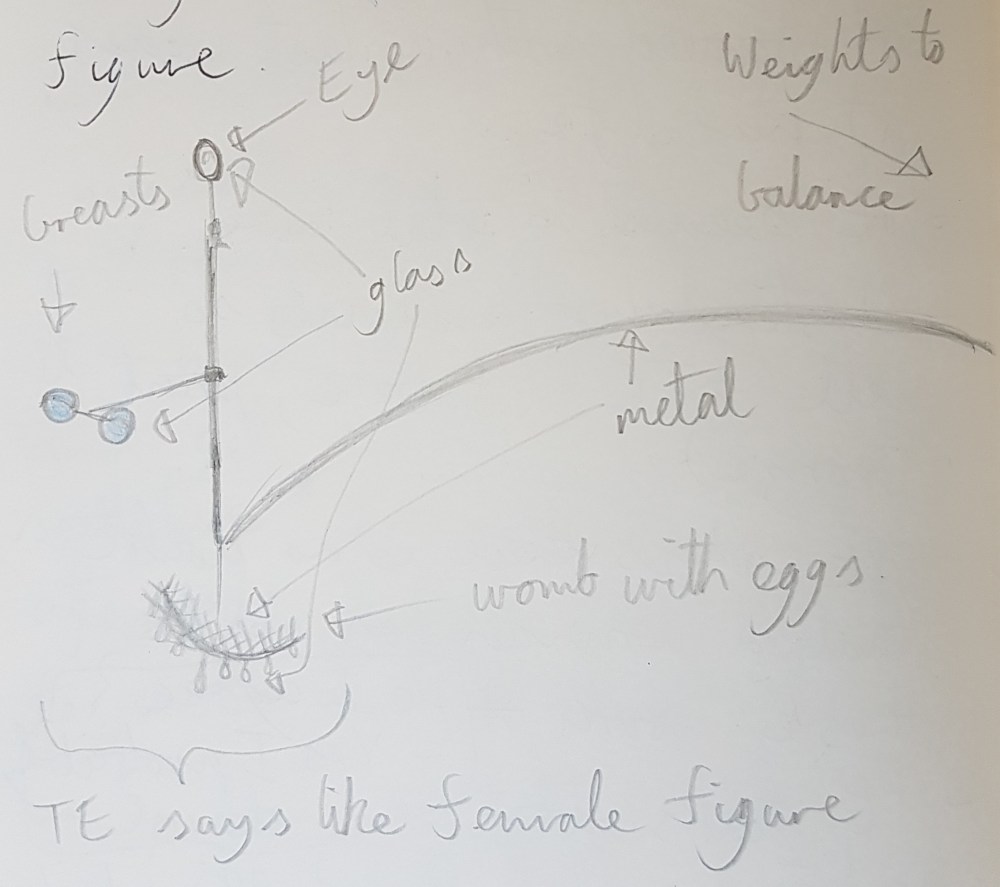
This fragile, spikey looking sculpture is cantilevered at one end with weights. The other end is glass and metal. Without the weights the beautiful fragility of the glass shapes at the other end would be destroyed and in this we see that this sculpture is about balance. Balance is also shown in her use of materials – fragile glass and strong metal. Tracey Emin when discussing this work says that much of Bourgeois’s work is about balance. In fact the title ‘Poids’ is French for weights and points to the balancing act this sculpture performs.
The glass shapes in the sculpture are somewhat like a female figure; the glass ball at the top: an eye, glass balls in the middle: breasts and the spikey, chandelier section at the bottom could be a womb. The spikey section at the bottom has droplets of glass hanging from it and encased in it; these could be eggs being protected by the spikey metal. This could be about the balancing act that is life and being a woman.
Triptych for the Red Room by Louise Bourgeois (1994)


These three panels made up of a combination of aquatint, drypoint and engraving, look initially sexual but that is not the meaning behind the work. If you look at the two figures in the work, one appears to be a woman and the other a boy. In the centre panel the female figure is leaping away from the male (Tracey Emin refers to the shape of the female figure as the ‘arch of hysteria’) and in both the outer panels the figures are joined at the hip but leaning away from each other. These figures are bound together but trying to lean as far away from each other as possible.
Both figures are screaming and appear terrified. The figures are so naked and vulnerable you can see their bones. This work is full of fear. This may be the fear and anxiety of a mother. How it feels to have an unspoken, desperate need to distance yourself from your child but you are uncontrollably bound together.
Do Not Abandon Me by Louise Bourgeois and Tracey Emin (2009-2010)

The series of works ‘Do Not Abandon Me’ is a collaboration between Louise Bourgeois and Tracey Emin. The images are a kind of call and response between the two artists. Bourgeois initially produced 16 images in various media (including watercolour as above) and sent them to Emin to work on them further. Emin added to them to them with ink. Bourgeois did not instruct Emin in what to add to the images and in this way it is like a conversation between the two artists.
Emin says the subject matter is ‘male and female images’. She says about some of the images ‘it’s actually about this tiny female figure actually paying homage to this giant male figure, almost like a god.’ I wonder if this is in response to a specific relationship in Emin’s life. Although she alludes to the fact that the images are not strictly sexual, they do have sexual elements to them and seem to be about intimacy. They may represent a feeling of protection you sometimes feel in a relationship or even feelings of subjugation. It may also be about a feeling of awe for the one of you love. There is definite synergy in this work and it is not obvious which elements are Bourgeois and which are Emin.
The image above entitled ‘I Lost You’ has a sadness to it. Bourgeois’s watercolour shading focuses on the breasts and womb of the figure thus highlighting that this image is about pregnancy, motherhood and loss. Again, it is not clear who added the writing ‘I Lost You’ but in this video Emin talks about how the image is about losing a child; through abortion, miscarriage or death later on. Emin talks about how you expect older people to die in your life but you never expect to bury your children. Bourgeois lost her son and the grief is clearly shown here.
The shape at the bottom of the image which appears to be drawn in ink, looks to be something protruding from the figure’s womb. It is not completely clear what this is but I think it looks like a baby’s arm or maybe a piece of umbilical chord. Whatever this piece of the image is, I feel that it represents the person that is lost. It is a piece of them, detached and incomplete. This creates the feeling of a figure that is missing, an empty space and so expresses feelings of longing and loss.
Give or Take by Louise Bourgeois (2002)
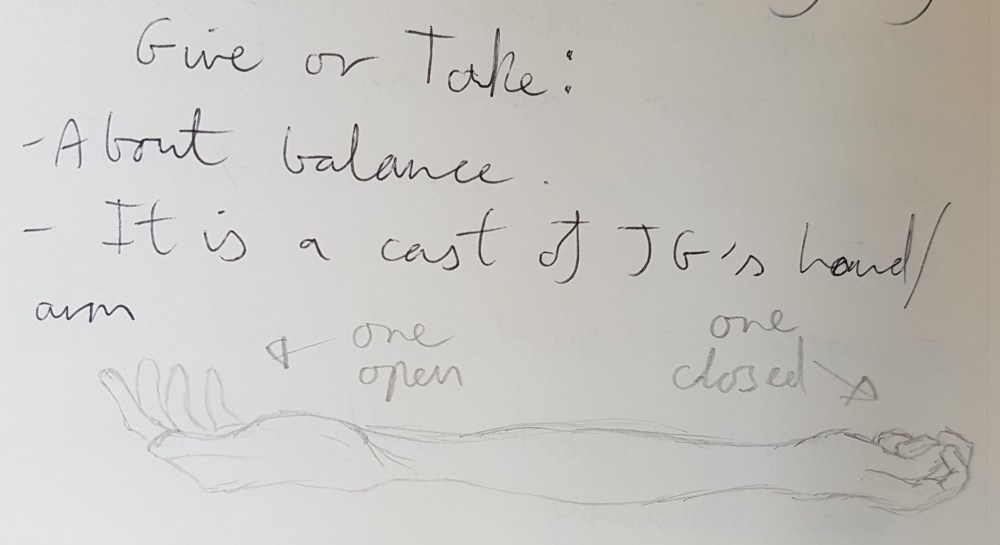
‘Give or Take’ is a bronze sculpture of an arm with a hand at either end; one hand open, the other closed. The cast is of Jerry Gorovoy’s arm/hand. Jerry Gorovoy was Bourgeois’s long term assistant and later in life her main carer. He says that her work was often about her interactions with someone else so it was important who’s arm/hand it was; it wasn’t just an arm, it was his arm. The piece could be about their relationship and the balance within in it. The closed hand is taking and the open hand is giving but they are part of the same limb. Each hand could be from either party in the relationship. The piece is about duality and two things co-existing together. Like much of her work it is simple but with complex meaning.
Gorovoy says that, to him, she remained a mystery right to the end. As a complex and mysterious person maybe this sculpture was her way of expressing to him her love and appreciation.
Self Assessment:
I am quite pleased with my work on this subject matter. I found the system I have of writing notes in my learning log book, then reading through them and typing them up onto my blog helped me analyse and re-analyse the subject. It has also helped me distil my notes and thoughts down into that which is most important.
Watching another artist and a curator discuss their thoughts on the work, also gave me a good insight into Bourgeois’s themes and artistic language, particularly as they both knew and worked with her. This will give me a good basis moving forward with the next task and has shown that it is important to do research across a range of media.
To fully understand and discuss some of the works I had to conduct some further research. This was mostly to find examples of works from a series or further images of a piece of work I wished to discuss. I found the MoMA website a very useful resource and I have saved it as one of my favourites for future reference.
It is worth noting that some of my initial notes were not entirely accurate and on a couple of occasions seem to misunderstand parts of what was being discussed. An example of this is that Tracey Emin, when talking about ‘Do Not Abandon Me’, says that ‘even though these images look sexual, it’s actually about this tiny female figure actually paying homage to this giant male figure, almost like a god.’ In my notes I wrote that Emin said that the images are not sexual but that is not strictly what she says. I think this error changed the meaning. What she says is not as black and white as I wrote in my notes; the images are not ‘not sexual’. I think she means that they are not particularly about sex and there is a difference here. This highlights the need for accurate note taking and revisiting the original source of information to clarify details.
I am also not a particularly fast note-taker and tend to write everything down rather than the main points. I had to pause and replay the videos several times. This skill, I am hoping, will come with practice. I am determined not to shy away from taking notes from videos because of this shortcoming. Videos are a very important resource and my note-taking will improve with practice.
An element of my research that I was quite pleased with was the small sketches that I made of some of Bourgeois’s work. This helped me further analyse and understand the imagery used in these pieces of work. Whilst they are not perfect drawings they served their research purpose well in furthering my understanding.
 Lucy's OCA Learning Blog