I have started a small A5 sketchbook to document my thoughts and experiment with ideas. This sketchbook does not have any particular topic or theme so I am free to work on whatever I am thinking about that day.
Below you can see the drawing I have produced on the inside cover and first page. This is a sketch of a view I used to see walking into work before the pandemic. It is of the Manchester skyline and has been drawn from a photo. The photo the drawing is drawn from was taken a while ago and given the rate of building work in the city, this view may now look very different. I used a black background on one side and white on the other to depict different times of day (in pencil). I also doodled some industrial looking shapes in the top right hand corner to make it look like the city is closing in on you. I am pleased with the contrast in this drawing.

On the next page in the sketchbook (below left) I did a further study in pencil and pen of one part of the skyline that interested me. It interested me because I have seen it grow out of nothing. On the same page below I have experimented with painting black gouache paint on a piece of card, letting it dry and then drawing a more abstract drawing of this view on top of the paint in silver pencil.
This process interested me so I have experimented further on the opposite page of the sketchbook (below right) with different brush strokes in gouache and again using silver pencil on top of black paint. Something that particularly interested me on this page was how the white paint, that is painted on top of black paint, cracked when the page was bent. These two pages are definitely more about experimenting with technique than the finished product but I feel like these pages of trying things out are of great use.


On the other side of the page from the gouache experiments I drew a study of two bicycles I found on a walk past Manchester University (below left). The bikes appeared to have had parts of them stolen but were still chained to a bike rack. As there was only really the frames left, these bikes reminded me of bones found in an archaeological dig or the carcass of an animal that had been picked at by other animals. When shading the ground around the bike I found that the bottom left hand side of the page had an interesting texture due to the cracked paint on the other side. I used this to depict the bumpy pavement next to the bike.
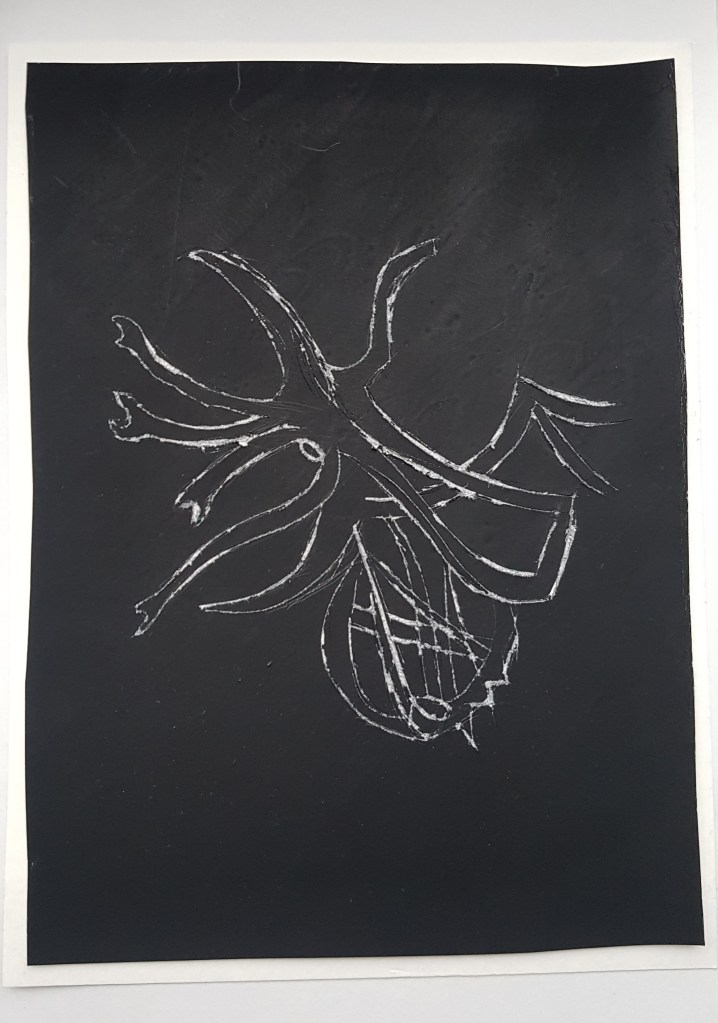
On the opposite page I decide to abstract the picture of the bikes (below right), using the shapes and lines seen in the original sketch as a basis. I also wanted to try a technique that I saw Geraldine Swayne use in her work, where she painted gouache onto a surface and then made marks by scratching the paint off. Due to using a different surface to Swayne’s work, the scratching marks I made appear slightly different. Swayne’s piece that I am referring to uses canvas rather than paper and the scratches are smoother. It may also be that Swayne produced her scratches when the paint was wet and therefore the paint behaved differently. In some parts of my drawing the scratching has caused the paper’s surface to peel up slightly . This gives the image a rough, natural look and I think this works well. This image almost looks like a prehistoric sea creature or the bones of prehistoric land creature which appears unfamiliar or deformed.


The next two pages were produced separately and do not relate to each other. The first is a doodle I made absent-mindedly one morning (below left). It is a drawing that felt like it created itself. The shapes in orange pencil appear to be like a cityscape that is cluttered, with all the buildings heaped on top of each other. It makes me feel like there is no room to breath. Underneath and upside down there is another group of shapes in the same configuration drawn in blue pencil, like a hidden city. I wrote underneath ‘tip of the iceberg’. This writing was not consciously led by any particular subject; it was just what I felt like writing. It may represent how overcrowded we are on this planet, country and in particular this city. It can feel claustrophobic at times. I sometimes fear that there are not enough resources to go around and that some of us take more than we need (we have seen this with pandemic panic buying). There is a serious homelessness problem in Manchester but it can often feel like this is ignored and many do not realise the extent of it or that this could happen to any of us.


The next page is very different. It is a pattern inspired by nature (below). This was inspired by a park near where I live. This park has been a sanctuary to me during the latest lockdown and I have found being close to nature very soothing. The park not only contains beautiful trees but also a flock of parakeets. I could not believe my eyes when I saw these brightly coloured birds in such a cold, rainy city. They were a wonderful surprise and a reminder how resilient nature is. The pattern is a combination of leaves and parakeet feathers.

The next couple of pages are also not related to each other. The first page has the urban fox drawing (below left) I refer to in my last post and features in the fluid media drawing it discusses. The shapes above the drawing of the fox are industrial in nature; they represent buildings, construction work and technology. This is a tribute to the urban foxes you see around South Manchester and the resilience of nature they represent to me.


The next page is a pair of observational drawings of my husband as he works on his biggest passion, electronic music (below). I am always amazed at his dedication to the music he creates and his ability to work on a piece for hours and hours without a break. I often have to prompt him to eat or leave the room he is in for fresh air. These drawings represent a particular day on which he had discovered a new piece of software that prompted him to experiment with new techniques. He did this all day; not noticing the beautiful sunrise outside (below top) or later the fact that it had become dark (below bottom). These two drawings represent the start and end of a long day of music making. I like how two drawings can be used to represent a large expanse of time.


Self Assessment
I think this sketchbook is going to prove invaluable. It is useful when embarking on a project to have a sketchbook focussed on the subject or process you are tackling. However, I also find it useful for generating ideas and for my mental health to have an experimental ‘anything goes’ sketchbook.
I am pleased with the painting experiments in this sketchbook. In particular, I pleased with the abstract, scratched drawing that is based on the sketch of the bikes. I feel that this has brought to life what I imagined when I saw these bikes, stripped of their parts. I imagined a rare, unfamiliar creature’s bones. The roughness of the scratched drawing makes it look more natural or maybe like a cave drawing of a now extinct animal.
The ‘tip of the iceberg’ drawing was a surprise but I think it represents a few thoughts or anxieties that I currently have. It is interesting and useful to see what come out when you don’t plan or think about what you are going to draw and I’m sure I will be able to build on this subject matter.
It was a challenge to draw my husband in his study as this is a person and environment I know so well and sometimes that can be a barrier to seeing what is really there. I enjoyed the challenge though and I think whilst it is not very detailed, it is a good representation. I am particularly pleased with the shading in the second picture showing that it is dark in the studio. This shows the benefit of drawing something in real life rather than from a photo.
I will continue to use this sketchbook and post the results.
 Lucy's OCA Learning Blog